Explore Starline, the Future Train of Europe: ambitions shouldn't be hindered by political disagreements
Starline: A Visionary High-Speed Rail Network Transforming Europe
The Copenhagen-based think tank, 21st Europe, has unveiled its first project: Starline, a groundbreaking trans-European high-speed rail network [1]. This ambitious project aims to connect approximately 39 major cities across Europe, including destinations as far as the UK, Turkey, and Ukraine, through a high-speed rail system designed to operate like a metro network [1][2][5].
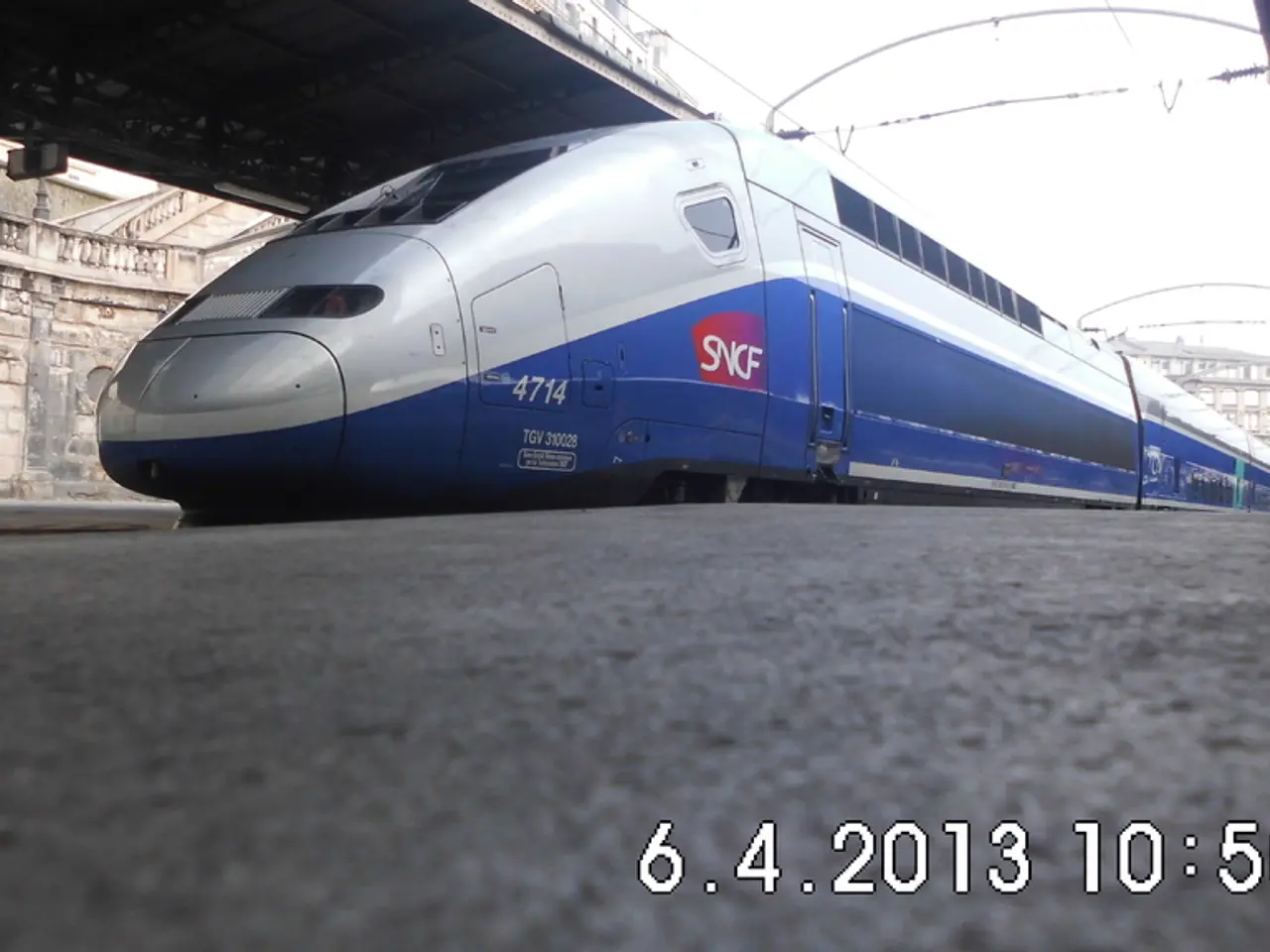
Starline is set to revolutionize transportation infrastructure in Europe, providing ultra-fast, reliable, and integrated rail connections that outperform current road and rail travel speeds by about 30%, with trains running at around 300 km/h [1]. The network, spanning about 22,000 kilometers, is planned to be operational by around 2040 [1][2].
Key features and aims of the Starline project include connecting over 400 cities across the European Union, plus the UK, Switzerland, and Turkey, via some 40 major hubs [2][4]. It seeks to link major ports and airports to create interconnected multimodal transport systems, facilitating seamless travel and trade [2][5].
One of the project's primary objectives is to offer a sustainable alternative to air travel, promoting low-carbon, high-speed rail journeys across Europe [2][5]. By overcoming Europe's historically fragmented and uneven rail infrastructure, Starline aims to pool existing resources and create dedicated high-speed tracks to unify national rail systems into a continent-wide network [1][2].
Starline also aspires to drive economic growth and regional integration by shortening travel times drastically. For example, the Lisbon-Madrid connection is expected to be reduced to about 3 hours by 2034 within this vision [3]. This would open new opportunities such as cross-border commuting and tourism.
The Starline project extends beyond the rail network itself. It includes an ecosystem that extends to apps, signage, and the deployment of train stations as new national landmarks. The network would significantly transform the way people, goods, and produce travel around the continent [6].
Kaave Pour, co-founder and head of Space10, has established a new agency named 21st Europe in Copenhagen. Pour describes Starline as an opportunity to apply Space10's way of working to something more systemic [7]. He hopes that 21st Europe will evolve into one of the most influential voices of design in Europe through alliances and partnerships [7].
Design and storytelling are the primary strategies of 21st Europe's approach for a soft power revolution, aiming to promote a sustainable and social agenda [8]. Pour emphasizes that trains have significant potential beyond the current narrative about autonomy and self-driving cars [9]. He believes that design needs to break out of its corporate, marketing, and branding silos to support new aspects of society and fulfill its true potential [9].
Pour's goal is to address the major issues facing Europe, especially in terms of infrastructure, with Starline [10]. He suggests the creation of a new European Rail Authority (ERA) within the EU [10]. The project is developed in collaboration with digital design and branding studio Bakken & Bæck and Parisian design studio Culte Commun [3].
Starline envisions a world of fast, reliable connectivity, shrinking borders, increasing trade, and bolstering security and cooperation [11]. It is inspired by successful examples of infrastructural visual communications, such as New York's yellow cabs and London's red buses [4]. The network will reach deep into Eastern Europe, including cities like Kyiv, Bucharest, and Sofia [4].
As China has made enormous cross-country investments in high-speed rail, with expectations to have 50,000km of high-speed rail by the end of 2025, Europe is poised to follow suit with the Starline project [12]. Pour believes that design needs to play a crucial role in shaping this future, and Starline is a testament to that belief [11].
References:
- https://21st-europe.com/starline
- https://www.dezeen.com/2021/02/23/starline-high-speed-rail-network-vision-21st-europe-copenhagen/
- https://www.dezeen.com/2021/02/23/starline-high-speed-rail-network-vision-21st-europe-copenhagen-kaave-pour/
- https://www.dezeen.com/2021/02/23/starline-high-speed-rail-network-vision-21st-europe-copenhagen-kaave-pour-design/
- https://www.dezeen.com/2021/02/23/starline-high-speed-rail-network-vision-21st-europe-copenhagen-kaave-pour-design-sustainability/
- https://www.dezeen.com/2021/02/23/starline-high-speed-rail-network-vision-21st-europe-copenhagen-kaave-pour-design-transport/
- https://www.dezeen.com/2021/02/23/starline-high-speed-rail-network-vision-21st-europe-copenhagen-kaave-pour-interview/
- https://www.dezeen.com/2021/02/23/starline-high-speed-rail-network-vision-21st-europe-copenhagen-kaave-pour-design-soft-power/
- https://www.dezeen.com/2021/02/23/starline-high-speed-rail-network-vision-21st-europe-copenhagen-kaave-pour-design-autonomy/
- https://www.dezeen.com/2021/02/23/starline-high-speed-rail-network-vision-21st-europe-copenhagen-kaave-pour-interview-infrastructure/
- https://www.dezeen.com/2021/02/23/starline-high-speed-rail-network-vision-21st-europe-copenhagen-kaave-pour-design-future/
- https://www.dezeen.com/2021/02/23/starline-high-speed-rail-network-vision-21st-europe-copenhagen-kaave-pour-design-china/
- The Starline project, envisioned by 21st Europe, intends to synergize with Europe's existing transportation infrastructure, linking cities across various industries such as finance, technology, and transportation in a continent-wide network.
- Upon completion, the Starline high-speed rail network is expected to promote economic growth and regional integration, fostering collaboration amongst key sectors including transportation, finance, and technology, ultimately creating an interconnected European Union.