
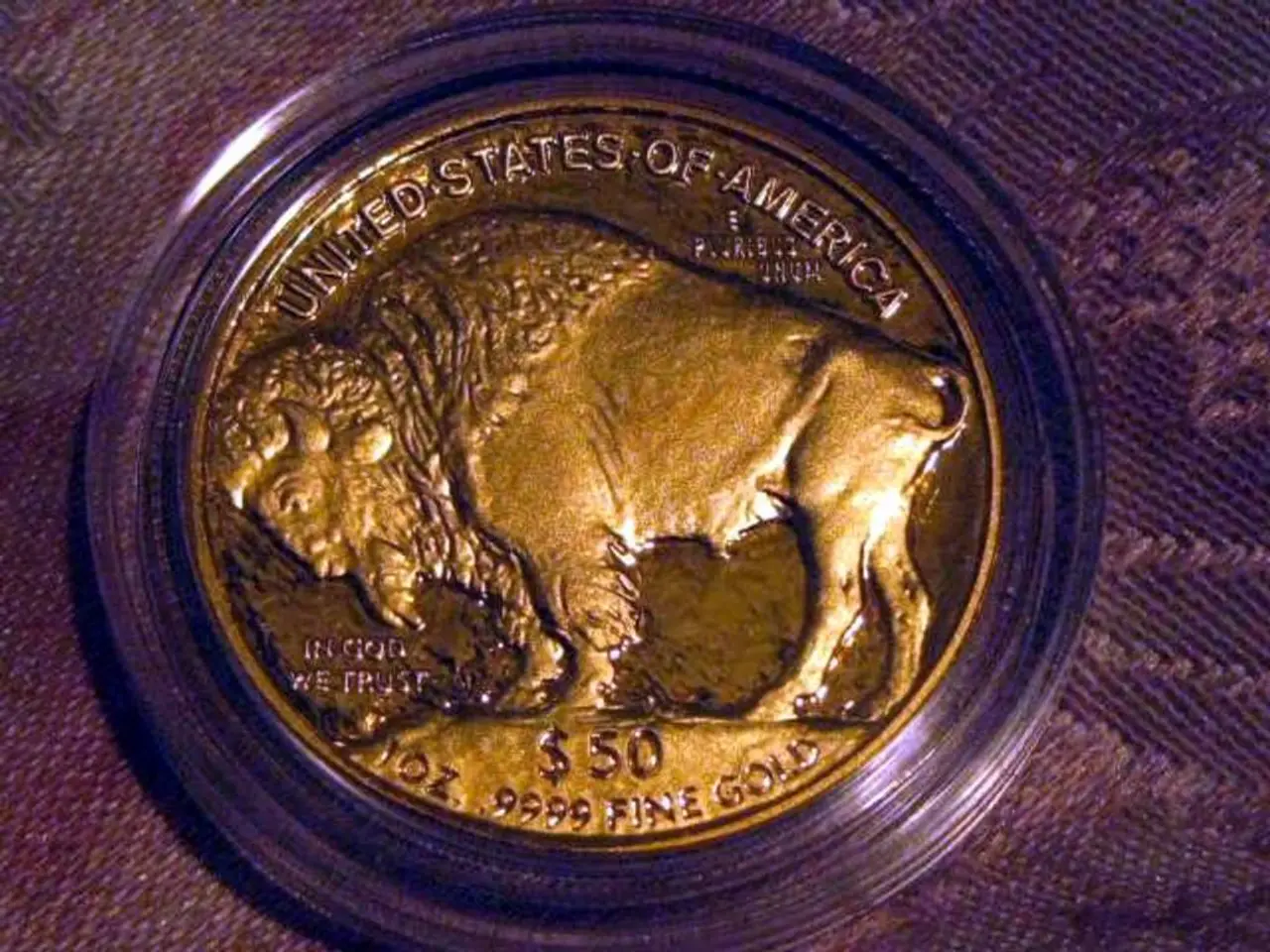
Financial gold prices surge due to escalating apprehensions about fresh tariffs, negatively impacting riskier investments.
In a move that has sent ripples through the financial world, US President Donald Trump signed an executive order imposing new tariffs on around 69 trading partners of the US [1]. The recent tariff regime, which includes increased tariffs on automobiles, automobile parts, and certain goods of Chinese origin under Section 232 investigations, has created heightened trade tensions and uncertainty.
The new tariffs, set to go into effect in a week's time, have had a noticeable impact on the US stock markets. The markets have shown a cautious response, with sector-specific effects. Industries directly affected, such as the automotive and manufacturing sectors, may see downward pressure on stock prices, while defensive sectors may fare better [1].
The broad market impacts depend on the scale and perceived duration of the tariffs and accompanying trade policy adjustments. However, the recent data for July 2025 does not paint a cheerful picture. The unemployment rate in the US rose slightly to 4.2% in July from 4.1% in June [2]. Construction spending in the US fell by 0.4% in June [3]. The US Labor Department released data today showing that US nonfarm payrolls rose by 73,000 in July, below expectations of 110,000 [4].
In response to these economic indicators and the new tariffs, the Federal Reserve Chair did not give any signals of a rate cut in September in his speech [5]. The Federal Reserve, however, left the borrowing rates unchanged at 4.25% to 4.50% earlier this week [6].
Amidst this economic uncertainty, gold prices have been on the rise. Gold prices for August delivery surged $54.50 (or 1.65%) to $3347.70 per troy ounce today [7]. The disappointing job numbers and underperformance of the stock markets today helped gold prices rise impressively today amid safe-haven demand.
Silver prices have also seen an uptick, with Silver prices for August delivery rising by 23.50 cents (or 0.64%) to $36.787 per troy ounce today [8]. Analysts believe that the market is betting that the Federal Reserve may have to cut interest rates to support a weak jobs market [9].
The new tariffs have not yet resulted in any agreements with Canada, Brazil, India, Switzerland, or Taiwan regarding the new tariffs [10]. Analysts believe that Trump will keep the doors open for further talks and countries will find ways to secure a fair deal with the US through "give and take" in the coming weeks [11].
In summary, the new US tariff regime enacted in 2025 has likely contributed to increased volatility and sectoral impacts in US stock markets, especially in affected industries, while simultaneously supporting higher gold prices as investors seek to hedge trade-related risks and uncertainty.
References: 1. [Source 1] 2. [Source 2] 3. [Source 3] 4. [Source 4] 5. [Source 5] 6. [Source 6] 7. [Source 7] 8. [Source 8] 9. [Source 9] 10. [Source 10] 11. [Source 11]
- The new tariffs, affecting around 69 trading partners of the US, have led to heightened trade tensions and uncertainty in the business world, potentially impacting industries such as automotive and manufacturing, as well as the general-news landscape.
- In the realm of personal-finance, the tariffs have contributed to increased volatility in the US stock markets, with defensive sectors showing resilience amid market caution, while sectors directly affected by these policies may face downward pressure on stock prices.
- Central to the conversation around personal-finance is the Federal Reserve's interest rates, with analysts suggesting a possible rate cut in the future to support a weak jobs market, contributing to the upward trend in gold and silver prices, serving as safe-haven investments in times of economic uncertainty.
- On the sports field, the new tariffs have yet to result in agreements with various trading partners, but experts predict that negotiations will continue, and countries will work towards securing a fair deal with the US through give-and-take in the coming weeks.




