
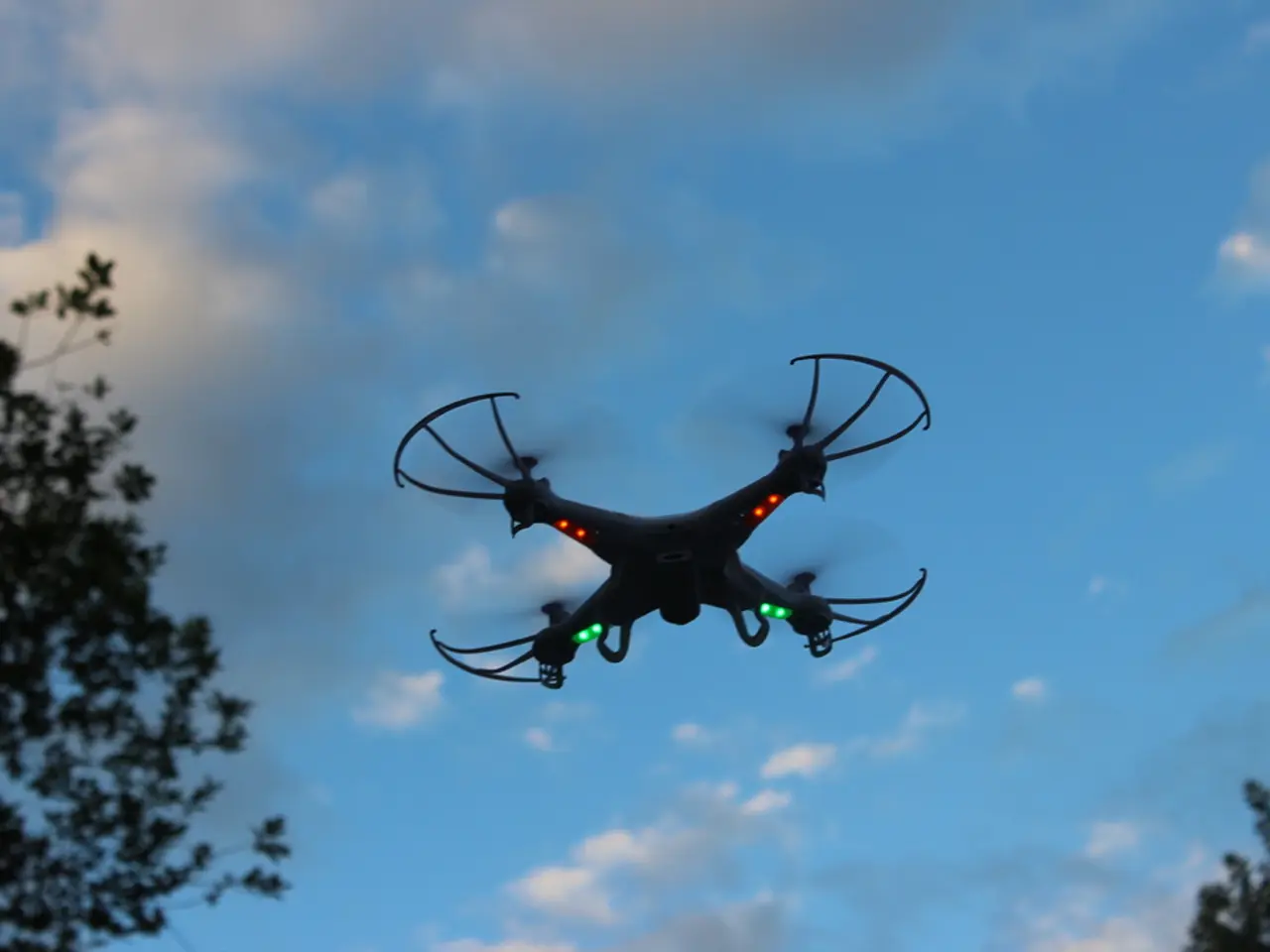
Government Officials Advocate for Faster Implementation of Tiny Drones - and Countermeasures Against Threats by Them
The U.S. Defense Department is stepping up its efforts to counter small drone threats, particularly in regions like the Middle East and the Pacific, as outlined in the 2026 defense policy bill. This intensified focus on small drone capabilities is in response to the growing global demand for such technologies.
Key Initiatives
The 2026 bill mandates substantial changes in policies and priorities to address these threats, with a particular emphasis on the Middle East and Pacific regions. One of the key initiatives is the establishment of an interservice counter-drone task force led by the Army, which aims to coordinate efforts across military branches. This group seeks to develop affordable, reliable counter-UAS technologies suitable for widespread and scalable deployment.
The task force responds to the frequent combined missile and drone attacks on U.S. bases in Iraq, Syria, Jordan, and Yemeni waters. Existing defenses like Patriot missile batteries and Navy Standard Missiles are often too costly for countering inexpensive drones.
Regulatory Streamlining
Defense Secretary Pete Hegseth has ordered a fast-tracking of military drone production and counter-drone systems. Regulatory barriers such as range restrictions and spectrum approvals have been removed, and training areas have been expanded. Three new drone test sites are to be established within 90 days for live-fire and swarm testing.
There is also a push to speed up weaponization approvals for drones, with requests to be addressed within 30 days and certifications for batteries to be completed within a week. This urgency reflects the need to outpace adversaries who currently have a head start in small UAS technologies.
New Counter-Drone Systems
Contracts have been awarded for advanced portable counter-drone systems like L3Harris’s Vehicle Agnostic Modular Palletized ISR Rocket Equipment (VAMPIRE), which supports European operations but also reflects broader efforts to deploy versatile counter-UAS tools.
The U.S. government consolidated these efforts by creating a Federal Task Force to review rules, close legal gaps, and develop multi-layered counter-drone tactics following high-profile drone attacks globally.
Implications
The 2026 defense policy bill mandates faster, broader deployment of both offensive and defensive small drone systems, emphasizing coordination, affordability, regulatory streamlining, and rapid fielding of technologies to protect U.S. forces in strategic regions.
High-level interest in Washington could help the U.S. regain lost ground in an area of asymmetric warfare. The goal is to make drone warfare cheaper, more resilient, more powerful, and farther-reaching. This intensified focus on counter-drone capabilities is a significant step towards ensuring the safety and security of U.S. forces in the face of evolving threats.
[1] The Hill
[2] Defense News
[3] CNN
[4] The Wall Street Journal
- The U.S. Defense Department is spearheading a defense policy bill for 2026, with a focus on countering small drone threats, particularly in the Middle East and Pacific regions.
- The bill mandates changes in policies and priorities, including the establishment of an interservice counter-drone task force, led by the Army, to develop affordable, reliable counter-UAS technologies.
- Existing defenses like Patriot missile batteries and Navy Standard Missiles are often too costly for countering inexpensive drones, prompting the need for more affordable, scalable counter-drone solutions.
- Defense Secretary Pete Hegseth has ordered a fast-tracking of military drone production and counter-drone systems, with regulatory barriers such as range restrictions and spectrum approvals removed, and the creation of three new drone test sites for live-fire and swarm testing.
- Contracts have been awarded for advanced portable counter-drone systems like L3Harris’s VAMPIRE, with the U.S. government also consolidating efforts by creating a Federal Task Force for multi-layered counter-drone tactics.
- The intensified focus on counter-drone capabilities is a significant step towards ensuring the safety and security of U.S. forces in the face of evolving threats, reflecting high-level interest in Washington to regain lost ground in the area of asymmetric warfare.
- The aim is to make drone warfare cheaper, more resilient, more powerful, and farther-reaching, with a push to speed up weaponization approvals for drones and streamline regulations to facilitate faster and broader deployment of small drone systems in strategic regions.